
Risk Score SDK
Collect a borrower's financial documents inside your product with a drop-in flow.
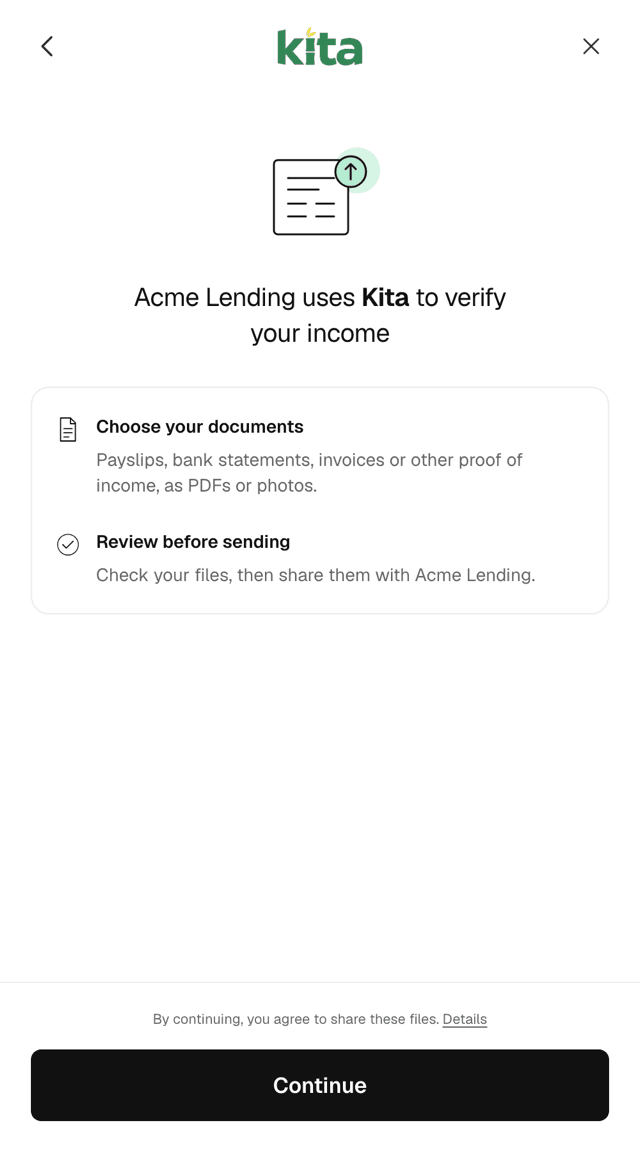
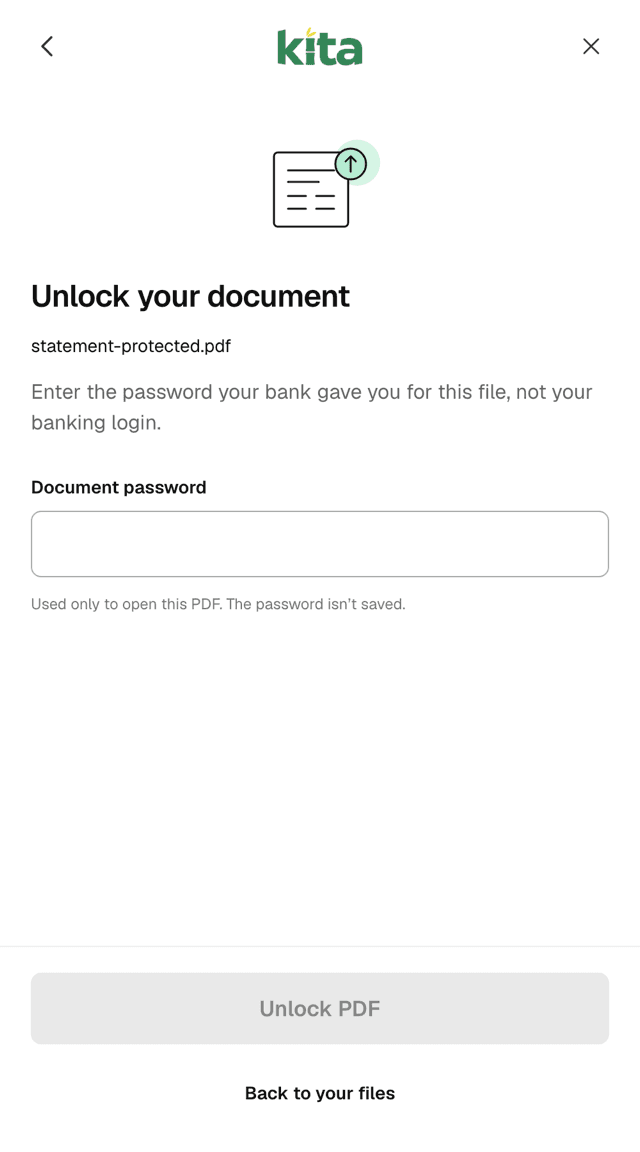
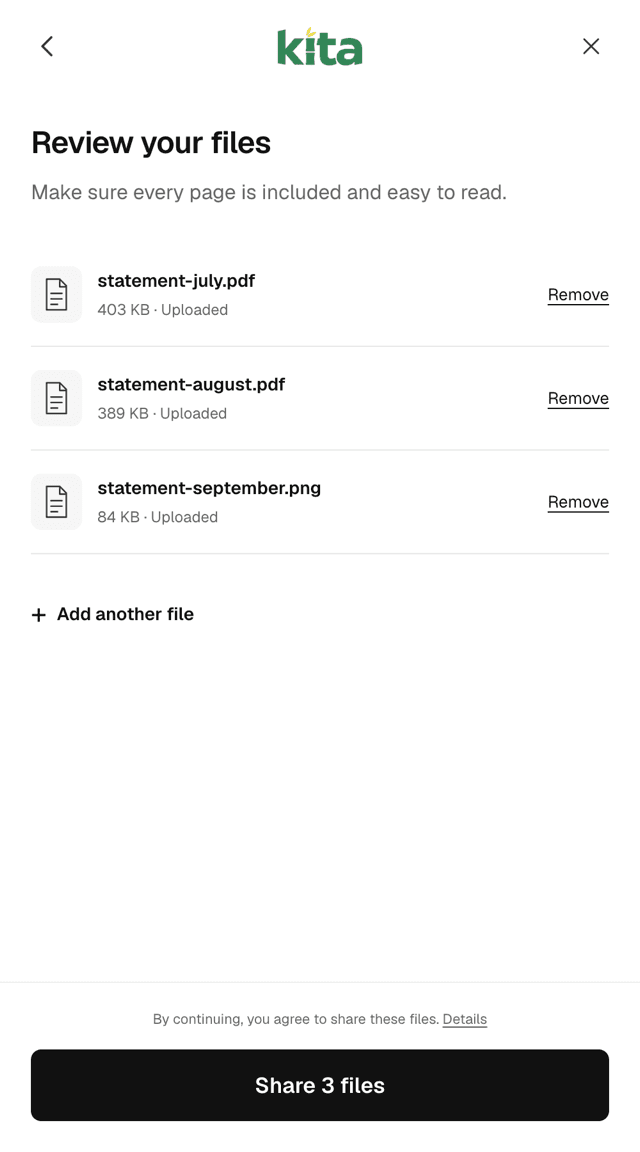
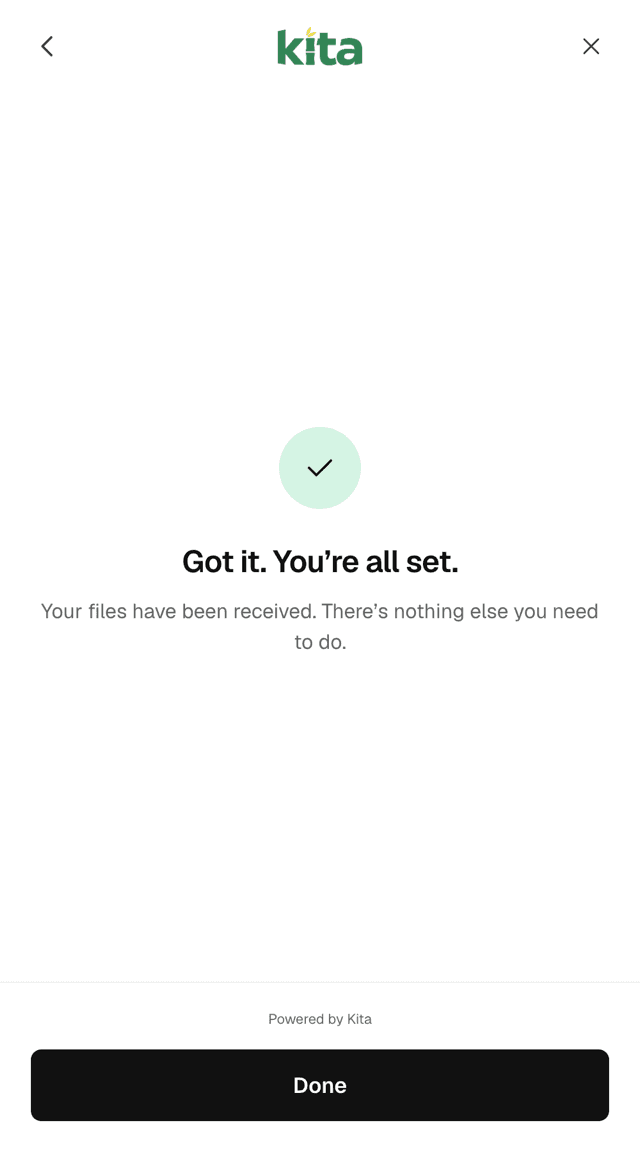
The Risk Score SDK is a drop-in flow for your web page or Android app. The borrower consents, chooses their documents as PDFs or photos, and shares them with Kita.
You write two things: a server call that creates a session, and a client call that opens the SDK. Every request needs your API key, and the key never leaves your server.
1 · Your server
Create a session
Call
POST /v1/risk/sessionswith your API key and your applicant ID. You get asession_idand a short-livedclient_token.2 · Your page or app
Open the SDK
Pass both values to
KitaRisk.create(). The borrower consents, picks their documents and shares them. Files go straight to Kita, not through your servers.3 · Kita
Read and deliver
Kita extracts and scores each file.
onSubmittedtells your page the borrower is done; a signed webhook tells your server processing finished.
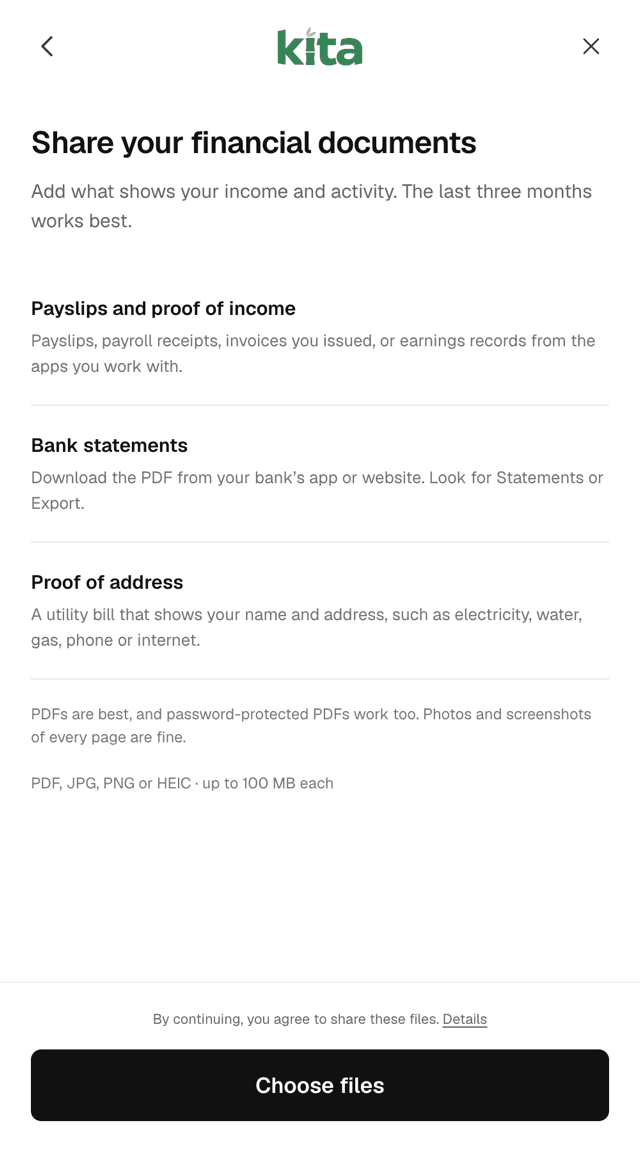
What the borrower sees
| Document | Examples |
|---|---|
| Payslips and proof of income | Payslips, CFDI payroll receipts, invoices the borrower issued, earnings records from gig platforms |
| Bank statements | PDF export from the bank's app or website, or photos of each page |
| Proof of address | A utility bill showing the borrower's name and address: electricity, water, gas, phone or internet |
PDF, JPG, PNG and HEIC, up to 100 MB per file and 12 files per session. The
borrower does not label anything; Kita detects the document type. English by
default, Spanish with language: 'es'. No bank login and no video.
Get the SDK
| Piece | How you get it |
|---|---|
| Web SDK | Nothing to download. Load https://<your-kita-host>/sdk/v1/kita-risk.js with a script tag, so fixes reach you without a release. |
| Python server client | Download kita_risk.py: one file, standard library only. Any HTTP client works too. |
| Android | No native library. The web SDK runs in a WebView; Kita shares a sample host app during onboarding. |
| API key and host | Issued by Kita during onboarding. |
Start here
- Quickstart: a working integration in three steps
- Web SDK and Server API: the full reference
- Android: the same flow in a WebView
How results reach you
Agreed during onboarding. Live scoring: your server reads scores after a signed webhook. Backtest: nothing is returned except session status, and Kita keeps each applicant's files and raw output for the backtest. See what Kita stores.